
Sri Rangam is the town near Thiruchirapalli, the central city of Tamil Nadu State. Earlier known as Dharma Rangam, Sri Rangam had got its name on the establishment of Sri Ranganatha Swamy Temple.
Legend
The initiation of the temple is believed to be in synchronization with the emergence of the universe.
Sri Narayana was floating on the serpent bed at the cosmic ocean and He had surmised that the time had come for the emergence of the universe. He had stemmed a lotus from His holy belly button and created Brahma.
When Brahma emerged on the lotus, He could discern only darkness. Bhagwan Vishnu had taken the form of a holy swan and appeared before Sri Brahma. Sri Brahma had asked the swan to explain the reason for His existence. The swan simply said “OM” and disappeared.
Sri Brahma had got hold of the Ekaakshar OM and started chanting it. Then from His mouth, the word “Bhoo”. Because of the holy and vibrant effect of the word “Bhoo”, Sri Brahma was able to create Agni (fire), Bhumi (Earth), Yajur Veda, Gayathri Devi, Brahmins and goat.
Sri Brahma continued His penance and then He pronounced “Bhuva”. With the intensity of this holy word, He had created Akash (Sky), Indra, Sama Ved and sheep.
Sri Brahma had again continued to do penance and He had pronounced “suvaha”. With this holy word, He had created Devalok, Rig Veda, Vysyas and cows.
From the continuous penance for the fourth time, Sri Brahma had created the word “mahaha”. With this, He had created Adharvan Veda and horses.
At that time, two demons named Madhu and Kaitaba had emerged from the ears of Bhagwan Sri Maha Vishnu and they had usurped all the Vedas from Brahma and went down the sea. Sri Brahma had followed them down the sea holding the lotus stem on which He was seated. But He could not spot the demons.
Sri Vishnu had appeared before Sri Brahma in the form of fish and promised Him that He would retrieve the Vedas. Bhagwan Vishnu had taken the form of Hayagreeva, diminished the demons and handed over the Vedas to Sri Brahma.
Sri Brahma had prayed to Bhagwan Vishnu for more enlightenment; Bhagwan had taught Vedas, Vedhanthas, Upanishad, Sasthras, Shilpa and Ayur Vedha to Sri Brahma.
Sri Brahma had made a lok called Sathya lok for Himself; He had then created panch boothas (five elements) and fourteen lokas [Satya, Tapa, Jana, Mahar, Swar, Bhuvar and Bhur lokas (upper seven lokas) AND Atala, Vitala, Sutala, Talatala, Mahatala, Rasatala and Patala (lower seven lokas)]. Despite such creations, He had realized that His position as creator is not permanent.
Hence, he did penance seeking the blessings of Sri Vishnu. Pleased with His penance, Sri Vishnu appeared as a tortoise (Kurma Avathar) before Him. The Tortoise had taught Ashtakshar Mantra of Narayana to Sri Brahma and disappeared.
Sri Brahma had done penance with Ashtakshar Mantra for nearly 1000 years. Then Bhagwan Vishnu had appeared as Sri Ranga Viman (having Sri Ranganatha) rising from the cosmic ocean.
The Ranga Viman was in the form of the mantra OM. The Viman was carried by Sri Garuda on His head; Sri Adi Sesha was the umbrella for the Viman; All the Devas were doing prayers to the Viman;
Sri Brahma had surmised that the entire galaxy of the universes is represented in the Ranga Viman.
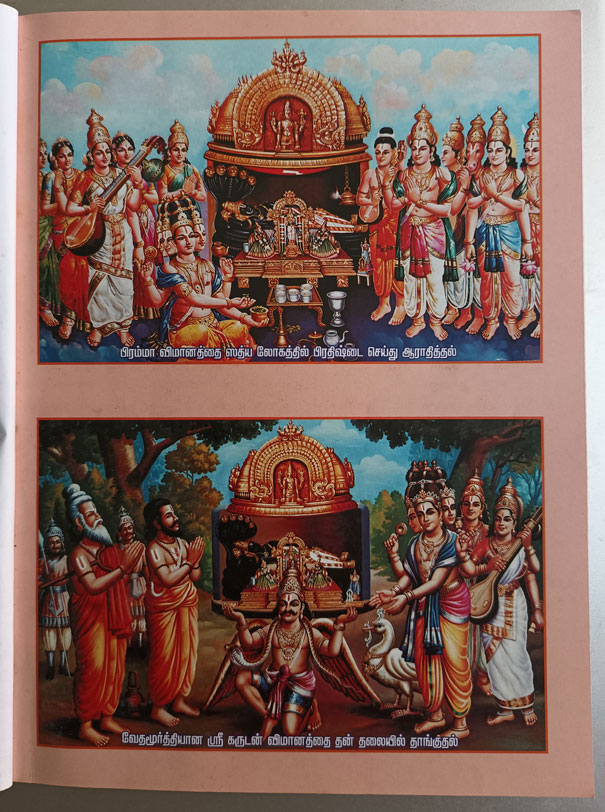
Ranga Viman – depiction
The upper portion was Dev lok; The lower portion was Bhu lok; The mid portion was Akash, the sky; Adi Seshan was inside; At the entrance, there were Jaya and Vijaya; In the sides, Vignapathy and Durga; In the shikar, at the top, Maa Saraswathi Devi as Omkara Rupini; Vedas and Vidhyas in the Kalash; Thathvas in the crevices; Yagnas at the feet; Sithi in Siddha; Ishti on the panes; Haviss in the inside depth; In the midst, saptha maraththu and ashta vasu.
Sri Ranga viman also contained twelve Adithyas, Nava grahas, 27 Nakshatras, Saptha Rishis, Ashta dig palaks, Chandra and Megha.
Sri Brahma had perambulated the Viman four times worshipping each and every Deity and entered the viman. Inside, He was blessed with the darshan of Sri Maha Vishnu as reclining on Adi Sesha as Sri Ranga Natha. Sri Brahma had prayed that Sri Ranganatha and the Viman should stay with Him forever.
Bhagwan had taught Him Sasvatham and Paushkaram, the elements of Pancha Rathra Sastra for worship. He had also ordained that Sri Brahma should so the worship and puja with five persons who are eligible to chant dwadasha akshar manthra of Sri Narayana.
Sri Brahma had taken the entire Ranga Viman to Satyalok and kept it at the banks of Viraja river. He had consecrated the temple with the help of Viswakarma on Krishna Paksha Rohini Star day of Thula month. He had made all the Devas including Surya to visit and worship Sri Ranga Viman. Bhagwan Surya had made His son Vaivasvatha Manu also as one of the Pujaris.
In the first of the Chathur Yuga, the descendent of Vaivasvathu Manu named Ishvaaku was ruling Ayodhya. He had asked his Guru Vasishta for attaining moksha and absolution in life. Sage Vasishta had told him that he should do the penance chanting Ashta Akshar Mantra of Narayana to bring the Ranga Viman to earth; Ranga Viman would remain in Ayodhya and then it would reach Cauvery river bank.
Ishvaaku and his wife went near the Ashram of Sage Vasishta and did penance as advised. Lord Indra got panicked that his Indra post would be usurped from him; He had sent Apsaras women to disturb the penance but King Ishvaku remained nonchalant.
Sri Brahma had surmised that Ranga Viman would be taken away from Him; So He prayed to Sri Ranga Nath to stay with Him only. Sri Ranga Nath had assured Him that Brahma should handover Ranga Viman to Ishvaaku as Sri Narayana had intended to stay in Ayodhya for four Yugas; At the fourth Yuga, He intended the Chola kings to worship Sri Ranganatha at the banks of Cauvery river; After seven Man Vanthras, the Ranga Viman would return to Satya Lok.
King Ishvaku had obtained Ranga Viman from Sri Brahma, kept it on His head and brought it to earth at Ayodhya. He had consecrated the viman to face the southern side. Sages Vasishta, Vama Dev, Japali, Kasyapa and other Munis had stayed near the Viman and did puja and worship to the Viman. Bhagwan Shri Ram was born as the descendent of King Ishvaku. Till His time, Ranga Viman was worshipped at Ayodhya.
In the Thretha Yuga of the fifth Chathur Yuga, Bhagwan Ram had defeated Ravan and got pattabhishekam as the King of Ayodhya. Chola King Dharma Varma Chola also had attended the function. At that time, the Chola King also had worshipped the Ranga Viman. He wished that Ranga Viman would come to Chola Kingdom.
He went back to his Chola Kingdom and tried to do penance on Sri Maha Vishnu to shift the Ranga Viman to his place. The Sages and Munis at the Cauvery banks told him that Ranga Viman would come to South and that there was no need for penance. So Dharma Raja Chola had decided to wait.
Meanwhile, Sri Ram had gifted the Ranga Viman to Vibheeshan for his services during the Lanka war. Vibheeshan had carried the Viman on his shoulders and came near Chandra Pushkarini river down south and kept it under a Punnaga tree.
Soon on consecration, Sri Dharma Varma Chola King and other sages started worshipping Sri Ranga Natha there. Vibheeshan also had participated in the prayers. A grand puja was done on Panguni Pournami day.
After the completion of the festivities, Vibheeshan tried to lift the Ranga Viman to take to Lanka. But he could not lift it. Sri Ranga Natha had told him that He would like to stay in the place and that He would take Vibheeshan to Him at the end of Shwetha Varaha Kalp.
Sri Ranga Nath also told that He would be reclining facing Lanka. Vibheeshan did perambulation of Sri Ranga Nath with tears in his eyes and left for Lanka.
There are five sanctums for Sri Ram in the temple premises.
The Chola King then had built the Gopuram, compound and mandapams around Ranga viman It is believed that the entire temple premises was under deluge and got buried under the river sand.
The descendent of Sri Dharma Varma Chola was ruling the place. One day, the king was returning from hunting and was resting under a tree. At that time, a parrot on the tree kept saying through a slokam that there was a Maha Vishnu temple in the area. The King was wondering where the temple would be.
That night, Sri Ranga Nath came in the king’s dream and showed him the place where the temple got buried. From next day onwards, the King and his men dug deep into the sand hill and retrieved the temple and added further structure to the premises.
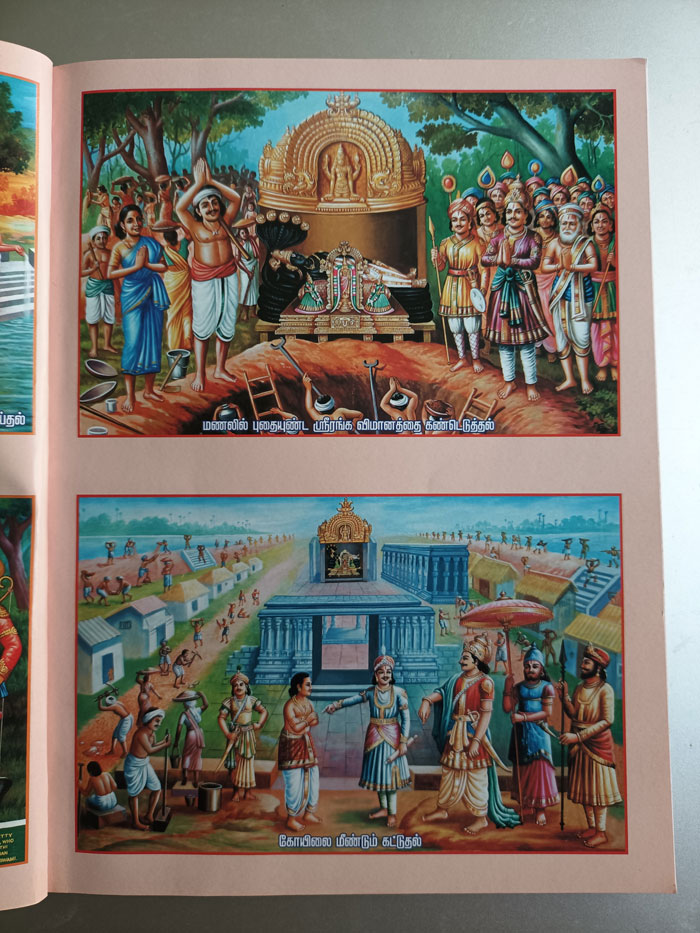
Temple structure
The temple premises itself is believed to be more than 6000 years old. The temple has seven precincts, twenty one gopurams and fifty one sannidhis. To have the darshan of Sri Ranganatha Swamy, the devotee should cross seven levels.
The street which encompasses the seven precincts is called as Adaya Valainthan Veethi. This street itself is revered as eighth prakara.
The seven precincts are said to represent seven lokas, viz., seventh Bhoo-lok, sixth Bhuvar-lok, fifth Suvar-lok, fourth Makar-lok, third Jana-lok, second Thapo-lok and the first Sathya-lok.
All the prakaras were constructed by Chola Kings and Nayaka Kings.
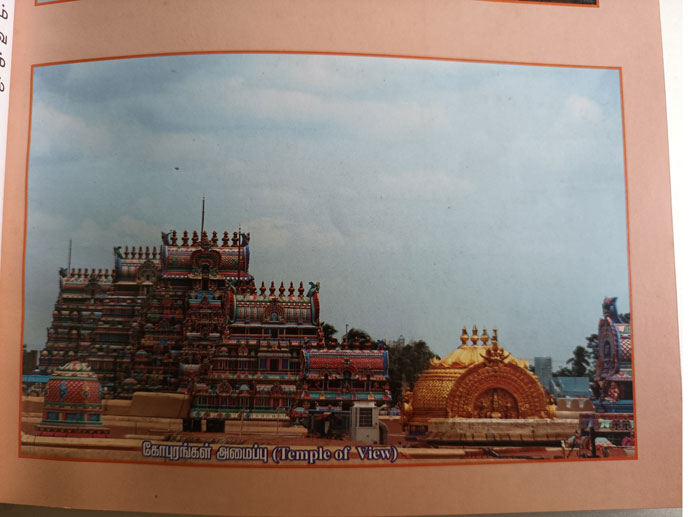
The way to enter the temple is from the Raya Gopuram in Adaiya Valainthan Veedhi. Earlier, this Gopuram was built by Vijaya Nagara Kings and was left unfinished. The 44th Jeeyar Swami had undertaken the completion of the Gopuram and it was done in 1987.
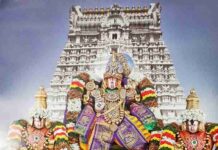
Now, this Raya Gopuram is the tallest in Asia with the height of 236 feet.
In a corner of Adaya Valainthan Veedhi, there is a sanctum for Sri Andal and Sri Periyalwar. As per the legend, Sri Andal and Sri Periyalwar had stayed in this place and worshipped Sri Ranganatha Swamy before Her marriage. This temple is said to be built by Sri Vallaba Deva Pandian, the disciple of Sri Periyalwar.
During Adi 18th day festival and Panguni Uthiram, Sri Perumal comes to this temple for exchange of garlands with Sri Andal.
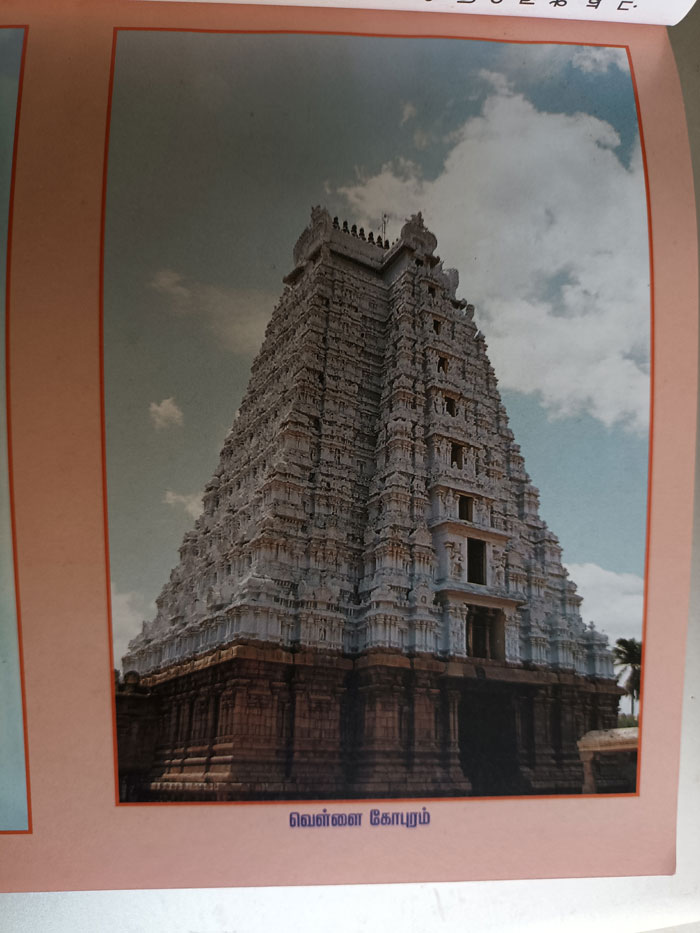
Seventh Precinct
The street where this precinct is situated is called as Chithirai Veedhi and Kaliyuga Raman Thiruveedhi. It has gopurams on all the four sides.
During Adhi Brahmothsavam in Panguni and during Chithirai Viruppan Thirunal Urchavam Sri Namperumal would come in palanquin and chariot to bless the devotees. On the last day of Vaikasi Vasantha Urchavam, Sri Perumal would come in horse vahana. During Masi Theppa Urchavam also Sri Perumal will appear in this precinct.
The north-east corner is called as Goratham as it had go-shala earlier.
Poornam and Pushkaran are the Dwara Palaks of this precinct. Sri Desikar Sannidhi and the Thiru Maligais of various Acharyas adorn this precinct.
Sixth Precinct
The street is called as Thiruvikraman Thiruveedhi. It has gopurams on all the four sides. Thai Chariot festival is conducted at this precinct. It is called as Bhupathi Thirunal.
In the south-east corner, there is a temple for Sri Manvala Mamunigal who is considered as the incarnation of Sri Adi Sesha. He has written explanatory essays on Dhivya-Prabandham. It is believed that Sri Ranganatha Swamy Himself had come as a small boy and listened to his verses. The main sanctum of this temple has inscription on his writings. There is a pravachana mandapam inside this temple. His padhukas are kept safely even to date.
Chakram and Shankam are the Dwara Palaks for this precinct. This also has Thiru Maliagais of various Acharyas and Mutts including Sri Ahobila Mutt.
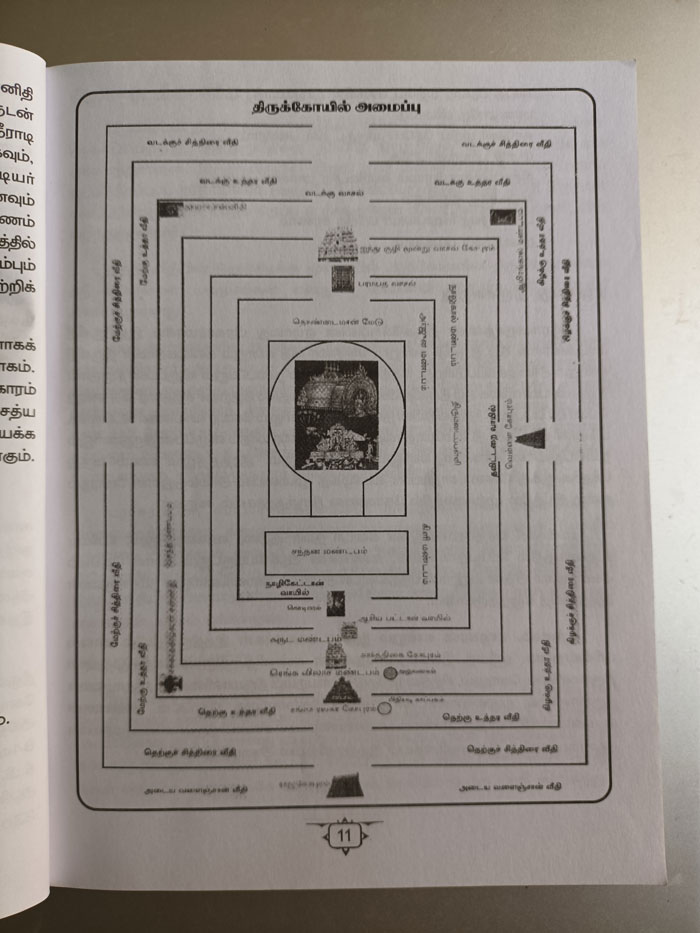
Fifth Precinct
This is called as Akalankan Thiruveedhi. The entrance to this precinct is through the gopuram called Naan-mukan gopura vasal. Akalankan means a person without any blemish and here, it is said to refer to Sri Vikrama Cholan.
At the entrance of this precinct, we get the Sannidhi of Sri Nadha Munigal alongwith Sri Alavandhan and Sri Thiruvaranga Perumal Arayar.
Near this Sannidhi, there is a mandapam in which Sri Perumal mounts on the elephant during festivals.
At the compound wall near Gopuram, Sri Koorathazhwar Sannidhi is in the east. In the north, there is a Sannidhi for Sri Thondar Adipodi Alwar facing west. Deepa Sthambam and Bali Peedam are situated in the northern corner of Sri Ranga Vilasa Mandapam. To the northern side of this Bali Peedam, there is a small shrine for Sri Bhaktha Hanuman.
Sri Andal Sannidhi is to the northern side of Yanai Mandapam. Sri Venu Gopala Swamy Sannidhi is nearer to that. Sri Veera Anjaneyar Sannidhi, Sri Thiru Paanazhwar Sannidhi and Sri Vittala Krishna Sannidhi are opposite to Sri Andal Sannidhi.
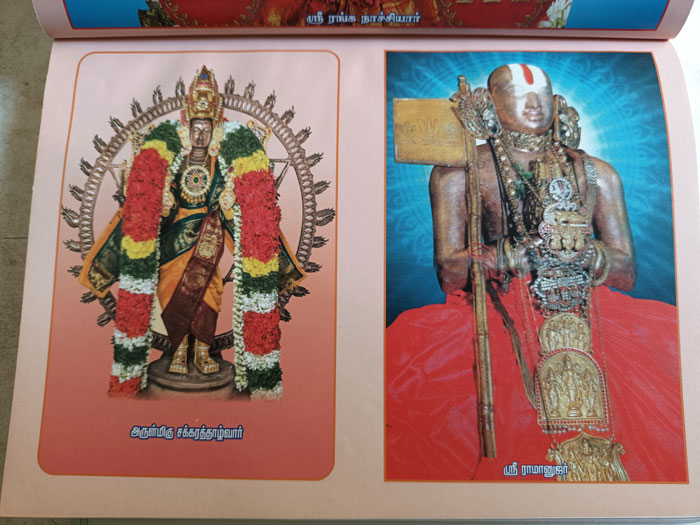
Sri Chakrathazhwar Sannidhi is in the southern side of Akalankan Veedhi. In this Sannidhi, Sri Yoga Narasimha is at the backside of Sri Sudarshana. In the south corner of the sanctum, there is a small sanctum for Sri Thiruvarangathu Amudhanar. On the way to Sri Chakrathazhwar sanctum, we get to see the Sannidhi of Sri Amrutha Kalasa Garuda.
Sri Ranga Nachiar sanctum is situated to the north-western side of Sri Chakrathazhwar Sannidhi. In Thayar Sannidhi, there are two moolavar vigrahas and one urchavar vigraham.
To the eastern side of Sri Thayar Sannidhi, we get to see the sanctum of Sri Mettu Azhagiya Singar. This Narasimha Swamy temple is said to be built by the King Sri Dharma Varma.
To the eastern side of Sri Ranga Nachiar sanctum, the sanctums of Sri Vedantha Desikar, Sri Periya Vachan Pillai and Sri Venkatamudaiyan are situated.
In the north east side of Akalanka Veedhi, we get to see the thousand pillar mandapam. Seshagiri Rayar Mandapam is just opposite to this. Sri Kothanda Rama Sannidhi is situated at the south east corner of this mandapam. The mandapam also has the sanctum of Sri Partha Sarathy.
In the south east corner of this precinct, we come to the sanctum of Sri Ramanuja Acharya. His Holy physical person is kept here for worship.
Next to Sri Ramanuja’s shrine, there is a museum related to spirituality.
Fourth Precinct
This is called as Alinaadan Thiruveedhi. It should be reached through Karthikai gopuram. On entrance, we get the darshan of Sri Garudalwar in a sanctum. The shrine is flanked by Sugreeva and Angadh. To the west of this shrine, the sanctum for Sri Maran Sadagopan, who had translated Vedas in Tamil is situated. The sanctum also has the murthies of Sri Nammalwar, Sri Madhura Kavi Alwar and Sri Thiru Mangai Alwar. To the south east of this sanctum, we get the darshan of Sri Thirukachi Nambi in a sanctum along with Sri Nava Narasimha.
When we do the perambulation of this precinct, in the western side, we can see Thiru kottaram. Near Thiru Kottaram, we get the sanctum for Sri Senkamala Nachiyar. To the north of Kottaram, we can see the sanctum of Sri Mela Pattabhi Ramar. To the north of this sanctum, we have the Sannidhi of Sri Poigai Alwar, Sri Bhoodhathu Alwar and Sri Peyalwar. To the north of this sanctum, we have the Sannidhi of Sri Theertha karai Vasudeva Perumal. Near this, the sanctums of Sri Dhanvanthri and Sri Lakshmi Narayana Perumal are situated.
Chandra Pushkarini and the Sthala Vruksha Punnai tree are opposite to Sri Dhanvanthri sanctum. The Pushkarini is surrounded by Sri Varahar, Sri Kothandaramar, Sri Parama Padha Nathar and Sri Varada Raja Swamy. Inside Sri Ramar sanctum, there is a Sannidhi for Sri Kulasekhara Alwar. At Parama Padha Nathan sanctum, Sri Bhagwan appears with Sri Devi, Bhu Devi and Neela Devi. Next to this sanctum, at Keezh Pattabhiram Sannishi, Bhagwan Ram blesses us with Sri Seetha Devi, Sri Lakshman, Sri Bharath, Sri Shatrugnan and Sri Anjaneya. To the south of this sanctum, we get the darshan of Manalveli Srinivasa Perumal.
Sri Bhoja Rama Sannidhi is to the south of Srinivasa Perumal Sannidhi. To the south of this Sannidhi, we can have the darshan of Sri Venugopal under Punna Tree with eight hands flanked by Sri Rukmini, Sri Sathya Bhama, Sri Radha and Sri Vasudev.
To the south east of this precinct, there is a sanctum for Thirumazhisai Alwar with Ganga and Yamuna as Dwara Palaks.
Third Precinct
This is called as Kulasekaran Thiruveedhi. It has to be accessed from Arya Bhatal Thiruvasal. Soon on entrance we get to see the place named as Aniyarangan Thirumutham where the Dwaja Sthamba and Bali Peeta are situated. To the west side, the sanctums for Sri Saraswathi and Sri Hayagreeva are situated.
The Parama Padha Vasal, the Vaikunt Dwar is the north entrance of this precinct. The well named Viraja Nadhi exists nearby. It is believed that Jeevathma would sanctify itself in Viraja Nadhi before entering Vaikunt.
The temple kitchen called Madappalli is situated at this precinct. Before the Dwajasthambam, we get the darshan of Sri Kambathadi Anjaneya Swamy. It is believed that the Deity was installed by Sage Sri Vyasa.
Sri Chakrathalwar and Sri Garudan are the guardians of this precinct.
Second Precinct
This is called as Raja Mahendra Cholan Thiruchurru. The entrance is called as Nazhigai Kettan Voil.
The temple treasury housing the ornaments and garments of the main Deity is situated in this precinct. The yaga sala for performing yagnas is situated in the north east.
Outside the yaga sala, there is a stage named Thondiaman Kuradu. It is also called as Vadavannai Thiruvasal and Panchu kondan vasal. Near this, there is a separate sanctum for Sri Vishwak Sena flanked by Sri Hanuman and Vibheeshan.
In the north east side of Arjuna Mandap, there is a sanctum for Sri Sera Kula Valli Nachiyar. There is also a sanctum for Thulukka Nachiyar.
In the south-east side of the precinct, there is a dedicated shrine for Sri Krishna. The vigrahas of Vasudeva, Devaki and Rohini are here. There is also an ornamental picture of Sri Srinivasa.
In the Chandana mandap, there is a dedicated shrine for Sri Garuda.
First precinct
This is called as Dharma Varma precinct. This contains the main sanctum of Sri Ranganatha Swamy.
Sri Ranga Viman constitutes the main sanctum. The gopuram is golden. The entrance is called as Kulasekaran padi. At the entrance, Sri Para Vasu Deva is the first Deity. His legs are the two pillars which are known as Kalyana Thoon.
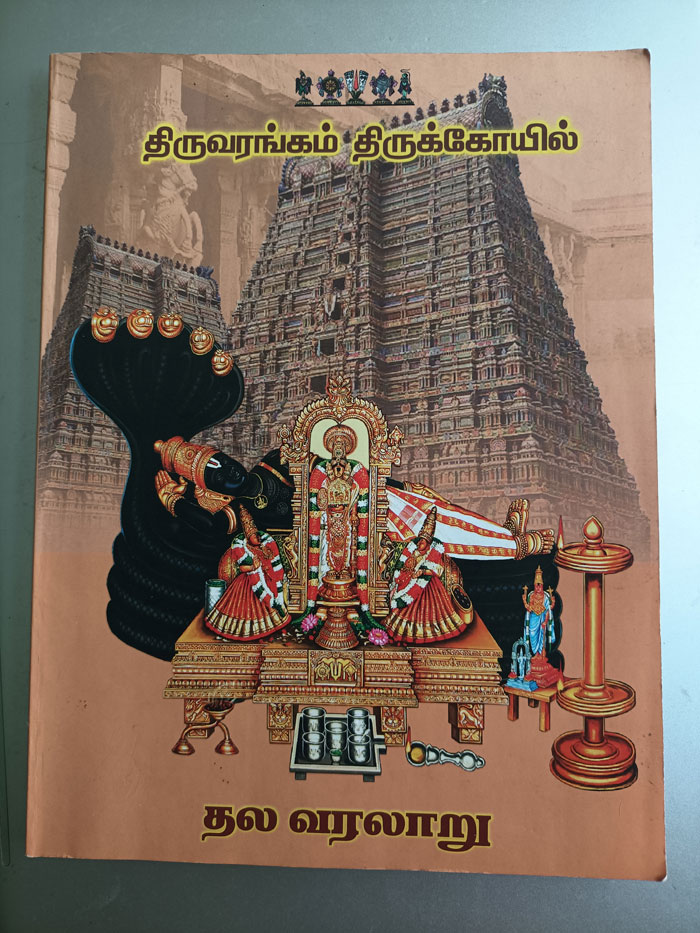
Sri Ranganatha is reclining on five headed adi sesha from right to left. He is facing east. The Urchava Murthy is Sri Ranganathar with Sri Devi and Bhu Devi. There are five other urchava murthies called Sri Kauthuga Perar (Nam Perumal), Pali Perar (Selvar), Yaga Perar, Theertha Perar and Sayana Perar.
At the main sanctum, Bhagwan Sri Maha Vishnu blesses His devotees as Sri Ranganatha Swamy, reclining on Adi Sesha. He is also hailed as Sri Bhujanga Sayana Perumal, Periya Perumal.
The Urchava Murthy is called as Nam Perumal and He is in standing position.
The Vimanam of the main sanctum is called as Pranavaa kaara vimanam.
Sri Maha Lakshmi blesses the devotees as Sri Ranga Nayaki Thayar. She is also called as Sri Ranga Nachiar.
Chandra Pushkarini, Kaveri river, Kollidam river and Vedha Shrungam are the Theerthams of the temple.
The Sthala Vruksham of the temple is Punnai tree.
Temple Mandapams
The significance of the several mandapams is given here.
Gayathri Mandapam is situated near the sanctum. It has 24 pillars signifying the 24 letters of Sri Gayathri Manthra.
Chandana Mandapam is adjacent to the doors of the main sanctum. Also named as Azhagiya Manavalan Mandapam, it has steps above and below. The steps are known as Ashtakshara Padigal. During Ekadashi and during festivals like Deepavali we can have the darshan of Sri Nam Perumal at this Mandapam.
Arjuna Mandapam is in the downside of Sri Senai Mudaliar sanctum. The mandapam has 72 pillars. During Pagal 10 days prior to Vaikunta Ekadashi, Sri Nam Perumal gives darshan here along with 12 Alwars at daytime. Divya Prabandam is recited.
Revathi Mandapam is in front of Arjuna Mandapam. As Sri Ranganathar gave first darshan on Revathi Star-day, special abhishekam called Thirumanjanam is performed to Sri Nam Perumal on all Revathi Star-days at this mandapam.
Kili Mandapam is to the south of Revathi Mandapam. As per the belief, when the temple was in ruins earlier, a parrot in this place had made the existence of the temple. On Diwali day, the Acharyas and Alwars would bless from this mandapam.
Thiruvanthi Kaapu Mandapam is in the southwest part of the second precinct and near the gopuram entrance of the fifth precinct. After procession on festival days, the Deities are kept here to ward off negative vibes.
Pavithra Urchava Mandapam is built by Kula Sekhara Alwar. Pavithra Urchava festival is observed in Avani month at this mandapam. In the western side, there are dedicated shrines for Sri Saraswathi and Sri Hayagreeva.
Thurai Mandapam is also known as Kula Sekharar Senai Vendran Mandapam.
Ulkodai mandapam is situated to the western side of Thurai Mandapam. During Puchaththum festival, Sri Nam Perumal blesses the devotees at this mandapam.
At Vedha Vinnappa Kosha Mandapam situated to the east of Ulkodai Mandapam, veda recitals take place.
There are separate Unjal Mandapams for Sri Namperumal and Sri Thayar. Sri Perumal’s Unjal Mandapam is to the east of Aryapatal entrance. This mandapam is built by Sadaya Varman Sundara Pandian. To the south of this mandapam, ghee containers are kept in the form of wells. Dolothsavam is also conducted at this mandapam.
The unjal mandapam for Thayar is in the north-west portion of Thayar Shrine.
Kodiyetra Mandapam is to the west of ghee wells. This mandapam has theertha pots.
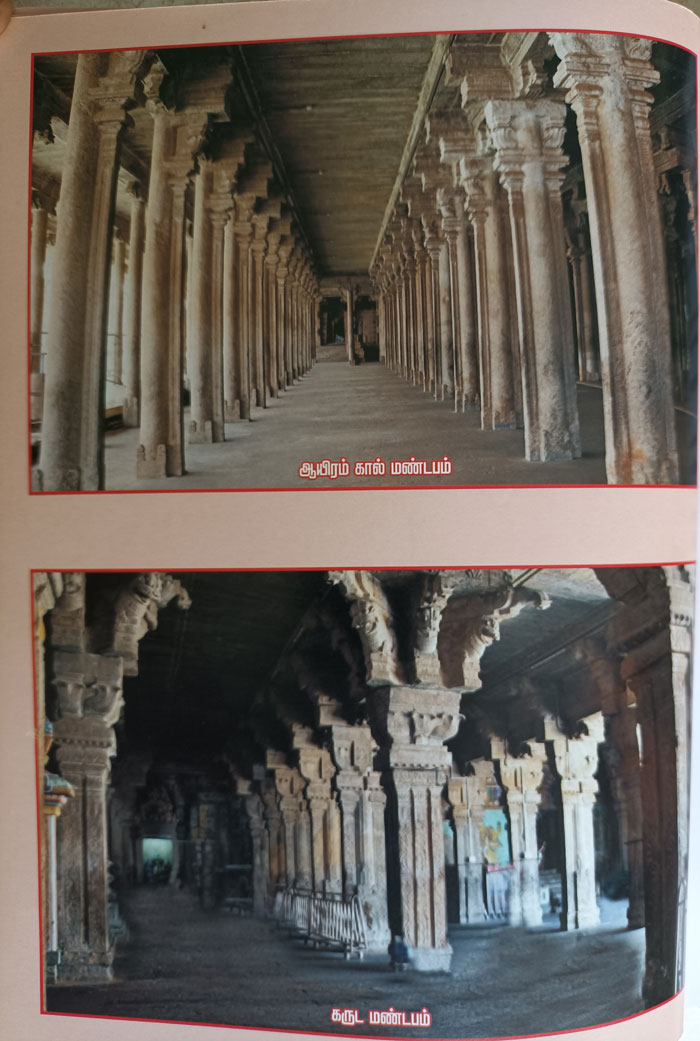
Garuda Mandapam is situated in front of Garuda Shrine. To the east lies Surya Pushkarini and the treasury having procession chariots and vahans.
To the west of Garuda Mandapam, Nel Alavu Mandapam is the place where paddy grains are measured with ancient containers in the presence of Sri Namperumal. This paddy measuring ceremony is observed on the seventh day of Thai, Masi, Panguni and Chithra month festivals.
Built by Thirumalai Naika King, Aranga Vilasa Mandapam is in the fifth precinct. Maha Bali Peedam and Ranganatha Deepa Sthambam are in the northern side of this mandapam. During Brahmothsva days Sri Namperumal blesses from here.
Vahana Mandapam containing the various vahanas for the processional Deities is to the north-west of Aranga Vilasa Mandapam.
There are two separate Vasantha Mandapams for Sri Perumal and Sri Thayar. Perumal Vasantha Mandapam is between the sanctums of Sri Thayar and Sri Chakrathalwar. This mandapam has surrounding moat on all the four sides. Sri Namperumal blesses here in Vaikasi month. The Vasantha Mandapam for Thayar is between Panguni Uthira Mandapam and Unjal Mandapam. This Vasantha Mandapam is also surrounded by moat.
Panguni Uthira Mandapam is in the south-west corner of Sri Thayar sanctum. On the ninth day of Panguni Brahmothsavam, both Sri Namperumal and Sri Thayar appear in this Mandapam in wedding attire.
Navarathri / Kolu Mandapam is in the front of Sri Thayar Sannidhi.
Sri Kambar Mandapam is inside the north entrance of Sri Thayar Sannidhi. Sri Mettu Azhagiya Singar (Narasimha) Sannidhi is facing this mandapam. Sri Kambar had done Arangettram / initiation of Sri Kamba Ramayanam at this Mandapam.
Karuthurai Mandapam is to the eastern side of Kambar Mandapam.
Ayirankal Mandapam is in the northern part of Akalankan Veedhi. Though called as thousand pillared mandapam, it has only 953 pillars. During Vaikunta Ekadashi festivals, Sri Perumal will be in the temple car shaped central mandapam during raa pathu days. The central mandapam is called as Thirumamani mandapam.
During festivities, 47 pillar-like structures made of coconut trees are kept in the front of Ayirankal Mandapam to make the count to 1000. Ayirankal Mandapam is said to be built during Vijaya Nagara King rule.
Sesha Rayar Mandapam having precious sculptures lies opposite Ayinrankal Mandapam.
Theerthams
Sri Rangam Temple has nine holy theerthams in the form of temple ponds. Chandra Pushkarini is the prominent of these and the other eight ponds are in eight directions of the main pond.
Chandra Pushkarini
This is near Sri Kothanda Rama sanctum in Ali Nadan precinct. As per the legend, Chandra had regained his glory after taking a dip in this pond and worshipping Sri Ranga. The Punnai tree at the bank is said to be planted by Indra.
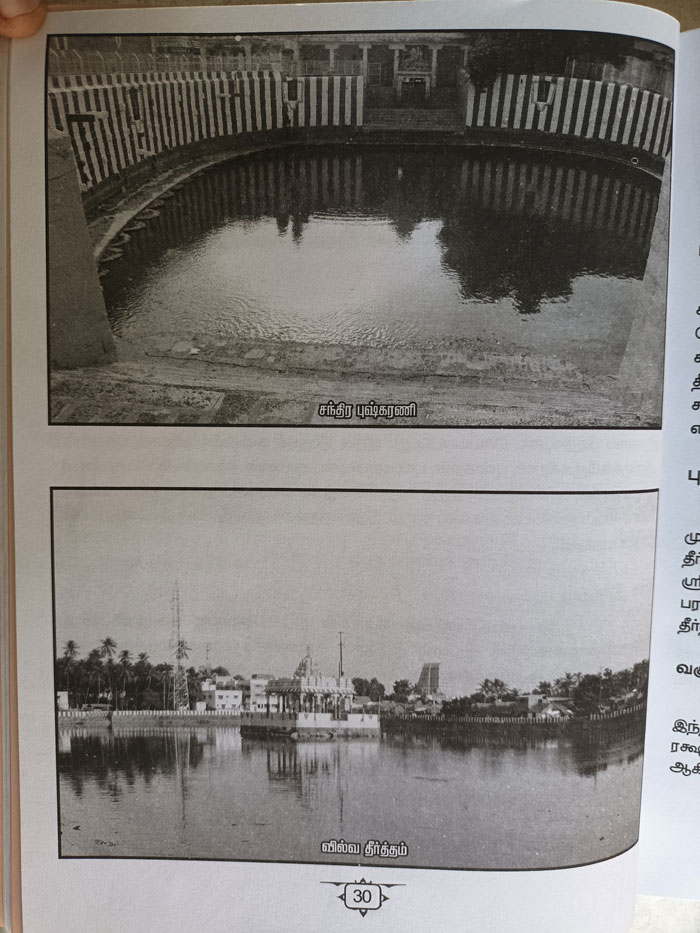
Sri Vyasa Maharishi is in the bund of this tank. The pond is said to be protected by Pushkaran, Pushkarakshan, Kumudhan and Kalan. It is considered auspicious to donate gingelly at this theertham.
Bilva Theertham
This is to the east of Chandra Pushkarini. This is near Kollidam bridge. It is believed that Sukracharya had attained salvation by taking holy dip at this pond. The Bilva tree at the tank bund is said to be planted by Sri Sukracharya. There is a sanctum for Sri Srinivas in this place. It is considered auspicious to donate gold at this theertham.
Aswa Theertham
This is to the south of Chandra Pushkarini. It is believed that Indra did penance here to alleviate the effect of Akalya’s curse. It is considered auspicious to donate clothes and doing kanyadhan at this theertham.
Palasa Theertham
This is to the south-west direction of Chandra Pushkarini. As per the legend, Bhagwan Muruga had done penance here and got His spear. It is considered auspicious to do go-dhan at this theertham.
Punnaga Theertham
Also called as Vrukshi Theertham, this theertham is to the west side of Sri Rangam at Melur. It is believed that Bhagwan Agni had done penance here. It is considered auspicious to donate ghee at this theertham.
Vagula Theertham
Also called as Kesara Theertham, this is situated near twin mandapam to the north-west of Chandra Pushkarini. It is believed that taking holy dip in this theertham would alleviate sins.
Kadhamba Theertham
This is to the north of Chandra Pushkarini. It is believed that Sri Janaka Maharaja had done penance here. It is considered auspicious to donate food at this site.
Amra Theertham
This is to the north east of Chandra Pushkarini near Thalakudi. Donating land is considered auspicious here.
Jambu Theertham
This is to the south-east of Chandra Pushkarini at Thiruvanaikka Temple. Donating foodgrains is considered auspicious here.
Apart from these, Surya Pushkarini at Garuda Mandapam, Amma mandapam padithurai and Theppakulam are the other theerthams.
Temple festivals
Bhagwan Sri Vishnu is also hailed as Nithyothsava Priyan. Everyday is literally a festival day for Perumal. All festivals have processions.
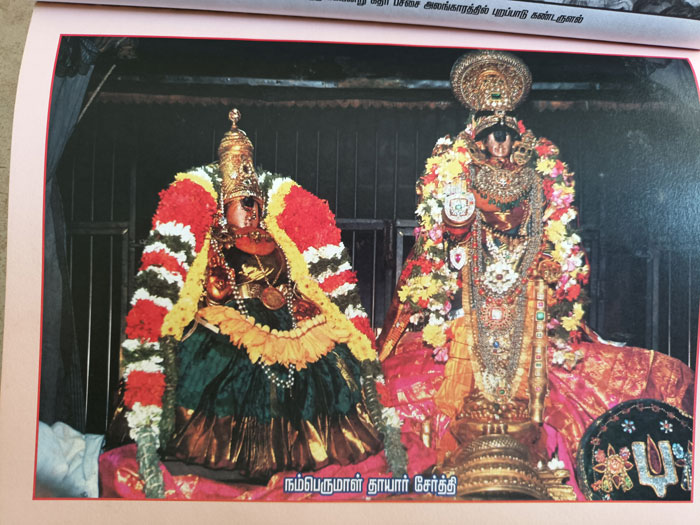
Traditionally, there is a standard procedure for every procession with respect to the speed and the style which is being followed till date.
Chithirai month
The festival commences eight days prior to Revathi Star-day. Sri Namperumal is taken in procession twice a day in various vahans such as karpaga vruksham, simham, elephant, yaali, garudan, Hanumanth, hamsam, silver horse, golden horse etc., in Chithirai veedhis.
On the seventh day, Sri Perumal blesses with Sri Ubaya Nachiar. There is a festival called “Nel Alavu” which means measuring paddy grains. It is the practice in Sri Rangam to chant “Thiruvarangam Periya Koil” for the first measurement whenever paddy is measured.
Ther or temple car festival is held on the ninth day which happens to be Revathi Star-day. As this Ther festival was initiated by Sri Viruppan Udayar, this festival is hailed as Viruppan Thirunal.
Kodai Thirunal or summer festival coincides with Chithra Paurnami. Velikkodai and Ulkodai festivals are held each for five days. Gajendra Moksham is observed on Chithra Paurnami day at the banks of Kaveri.
Vaikasi month
Vasanatha Uthsavam commences just eight days prior to Vaikasi Paurnami day. Sri Nam Perumal blesses from Vasantha Mandapam where water is poured in the moat surrounding the mandapam. On the ninth day Sri Nam Perumal goes on procession on horse vahana.
Ani month
On the Jeshta Star-day (Kettai), jeshtabhishekam is performed for Sri Nam Perumal. Holy water is taken from Kaveri river in gold and silver pots and abhishekam is performed. On the next day 1400 padi rice is cooked and kept as display at the main sanctum entrance. To the rice, mango, jack fruit and plantain fruits are added alongwith ghee and coconut. The prasadam is distributed to devotees.
Adi month
On Adi 18 or Adi Perukku day, Sri Nam Perumal blesses at Amma Mandapam. Kaveri river is worshipped with flowers.
Avani month
On Sri Krishna Janmashtami day, Uriyadi festival which is equal to handi festival is celebrated. Abhishekam is performed to Sri Nam Perumal on that day.
Commencing from Sukla Paksha Ekadashi of the month, Pavithra Uthsavam is held for nine days. On the second day (Dwadashi), sacred thread is adorned for all the Deities in the main sanctum after abhishekam.
Kozhukkattai (rice dumplings) are made and offered as Neivedyam to Bhagwan Ganesh and Vishvak Sena on Sri Vinayak Chathurthi day.
Purattasi month
Navarathri id celebrated with reverence at the sanctum of Sri Thiruvaranga Nachiar. On Vijaya Dashami day, Sri Perumal will be taken in procession to Sri Kaatazhagiya Singar Temple.
Aippasi month
Unjal Urchavam commences on Krishna Paksha Ekadashi and is conducted for nine days. On the ninth day Sri Perumal has Theerthavari in Chandra Pushkarini.
During this month, abhisheka water is taken from Kaveri river in the golden pot.
On Deepavali day, Sri Nam Perumal will have thaila abhishekam. Azhwars and Acharyas will come to Kili Mandapam. Sri Nam Perumal will be at Chandana Mandapam. Two bagful of coins will be kept near Sri Perumal.
Karthika month
On Thiru Karthika day, agni pradishta will be done at the divine kitchen of the temple and nine lamps shall be lit. Sri Nam Perumal will come before Sri Chakrathalwar sanctum for Chokkappanai festival.
On Kaisika Ekadashi day, Sri Perumal will come to Arjuna Mandapam. Kaisika puranam will be recited. Sri Perumal will be adorned with 365 silk vasthrams on that day.
On the next day, camphor shall be lit on the Yazhi mandapam steps and when Sri Nam Perumal is taken into the mandapam, devotees offer pacha karpooram to the Deity.
Margazhi month
During this month, every morning, Thiruppazhiyezhuchi (devotional waking up) will be sung alongwith Thiruppavai. Sri Vaikunta Ekadashi, also known as Thiru Adhyayana Uthsavam is an important festival of this month. The period of 10 days prior to Vaikunta Ekadashi is called as Pagal Pathu and Thirumozhi Thirunal. During this period, Sri Namperumal shall adorn Arjuna Mandapam.
On Vaikunta Ekadashi day, the Moolava Deity shall be adorned with a pearl studded holy garment called Muthangi. Sri Namperuam shall adorn ruby studded holy garment and will come to Thirumamani mandapam in 1000 pillar mandapam through Parama Padha Vaasal (Gateway of heaven).
The process of entering into heaven shall be enacted with pasurams.
The period of ten days after Vaikunta Ekadashi is called as Raa Pathu and Thiru vay mozhi Thirunal.
During Pagal Pathu and Raa Pathu days, the pasurams praising Sri Perumal shall be sung and enacted.
Thai month
On Makara Sankaranthi day, Sri Namperumal alongwith Ubaya Nachiar will bless the devotees at Sankaranthi mandapam.
Temple car festival is also observed during this month.
A festival named Kadhir Alangaram is celebrated whereby harvested paddy is taken on elephant and submitted to Sri Perumal.
Masi month
Nine-day float festival named Theppa Thiruvizha is observed. Sri Nam Perumal is taken on procession. Garuda Seva is prominent during this festival.
Panguni month
The annual Brahmotsavam, a ten-day festival culminating on Panguni Uthiram is observed in a grand manner.
Apart from the regular festivals, during Revathi Star-day, Ekadashi, Month starting day and Amavasya of every month, abhishekam named Thirumanjanam is done to Sri Nam Perumal.
Pujas are conducted at this temple as per Pancha Rathra principles.
The details of this temple are said to be described in Brahmanda Puranam, Garuda Puranam, Pancha Rathra Parameshwara Samhitha and Srimad Ramayanam.
The temple is replete with sculptures and paintings. Most of these artefacts date back to Chola, Pandiya and other prominent Kings.
There are several literary compositions praising the Deity and the temple. Prominent among them are Sri Ranganatha Sthavam, Sri Guna Rathna Kosam, Sri Ranga Vimana Mahathmiyam, Sri Ranga Brahma Vidhya, Sesha Dharmam and Sri Ranga Mahathmiyam. Alwars had composed nearly 250 pasurams in prayer to Sri Ranganatha Swamy.
Sri Rangam is at Thiruchirapalli, Tamil Nadu. It is easily accessible.
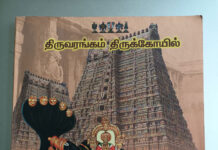
The contents of this article are sourced from the booklet, “Thiruvarangan Thirukkovil Thala Varalaru”. The booklet is available at the temple premises. As taking photos at the temple is prohibited, the pictures in the booklet are given for reference in the article.